




By TechNews Editor | Published in Innovation & Hardware
The rapid advancement of quantum computing poses an unprecedented challenge to global digital security. Today’s internet security backbone—including RSA and Elliptic Curve Cryptography (ECC)—relies on the mathematical difficulty of factoring large prime numbers or solving discrete logarithms. While these algorithms would take classical supercomputers thousands of years to crack, a sufficiently powerful quantum computer running Shor’s Algorithm could break them in minutes.
To prevent a total collapse of global cybersecurity, government agencies, financial institutions, and cloud providers are accelerating the transition to Post-Quantum Cryptography (PQC).
The “Harvest Now, Decrypt Later” Threat
cybersecurity experts warn of a pressing threat known as “Harvest Now, Decrypt Later.” Adversaries and malicious actors are currently intercepting and storing vast volumes of encrypted state and enterprise communications.
Even if quantum computers capable of breaking RSA remain years away, encrypted data captured today can be decrypted retroactively once functional quantum processors mature. This reality makes immediate implementation of post-quantum standards a critical priority.
Standardizing Quantum-Resistant Algorithms
Unlike quantum key distribution (QKD), which requires specialized physical hardware, post-quantum cryptography involves software algorithms that run on existing silicon hardware and internet protocols.
According to standards finalized by the NIST Computer Security Resource Center (CSRC), the primary foundation for post-quantum defense relies on Lattice-Based Cryptography:
- Lattice Structures: These algorithms base their security on complex multi-dimensional geometric lattice problems that are exceptionally difficult for both classical and quantum computers to solve.
- CRYSTALS-Kyber & Dilithium: Primary public-key encryption and digital signature algorithms selected for global standardization, delivering robust security with optimized key sizes.
Further background on quantum-safe mathematical structures can be explored via Wikipedia’s Post-Quantum Cryptography overview.
Upgrading Hardware Security Modules (HSM)
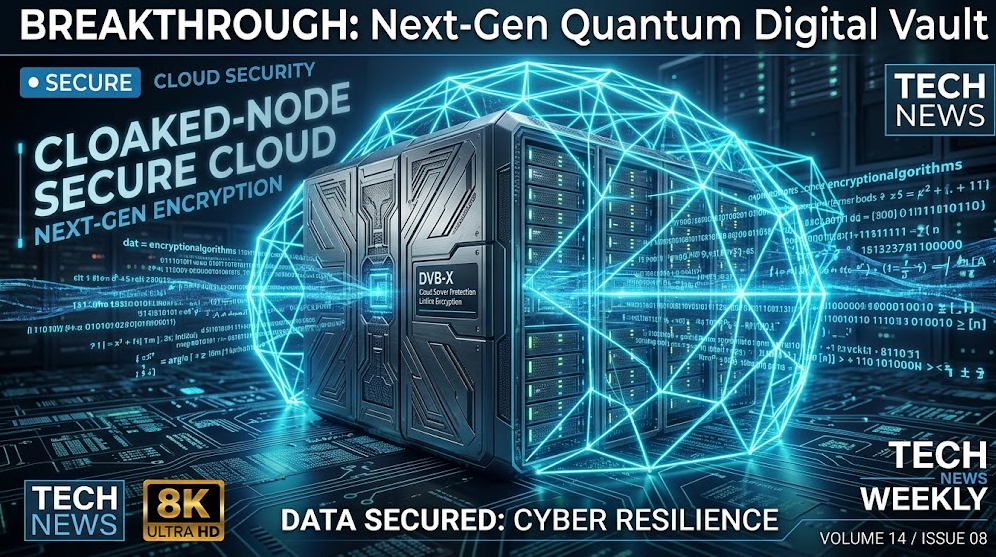
Implementing PQC requires significant processing overhead. Quantum-resistant keys and signatures are substantially larger than classical RSA counterparts, impacting memory footprints and network packet sizes.
As detailed in research from ACM Queue, cloud data centers are upgrading dedicated Hardware Security Modules (HSMs) and secure enclaves to process lattice-based math natively without degrading application performance.
Preparing for the Quantum Transition
As explored in our ongoing hardware and security breakdowns in Tech today, achieving quantum resilience requires total cryptographic agility.
Organizations must inventory their current software stacks, identify legacy encryption dependencies, and integrate hybrid cryptographic protocols that combine classical and post-quantum protection during the transition era.