





By TechNews Editor | Published in Innovation & Hardware
The clean energy transition and the rapid expansion of electric mobility are placing unprecedented demands on energy storage systems. While traditional lithium-ion batteries have fueled the portable electronics revolution for three decades, they are rapidly reaching their physical energy density limits, thermal stability ceilings, and charge-rate capabilities.
To break through these performance bottlenecks, automotive engineers and materials scientists are pioneering the next commercial leap in energy storage: Solid-State Battery Technology.
Beyond Liquid Electrolytes: How Solid-State Works
Standard lithium-ion cells rely on volatile liquid electrolytes to transport lithium ions between a graphite anode and a metal oxide cathode. While effective, liquid electrolytes are flammable, susceptible to dendrite formation (short circuits), and require heavy thermal cooling systems.
According to research from the U.S. National Renewable Energy Laboratory (NREL), solid-state architecture replaces liquid chemistry with solid materials—such as ceramics, sulfides, or solid polymers:
- Higher Energy Density: Solid-state cells can achieve double the volumetric energy density of traditional lithium-ion batteries, allowing longer EV range without increasing vehicle weight.
- Enhanced Thermal Safety: Eliminating flammable liquid electrolytes drastically reduces fire risks, allowing simpler and lighter battery pack designs.
- Ultra-Fast Charging: Solid electrolytes accommodate higher current densities, enabling 10-to-80 percent charging cycles in under ten minutes without severe degradation.
The Silicon Anode Breakthrough
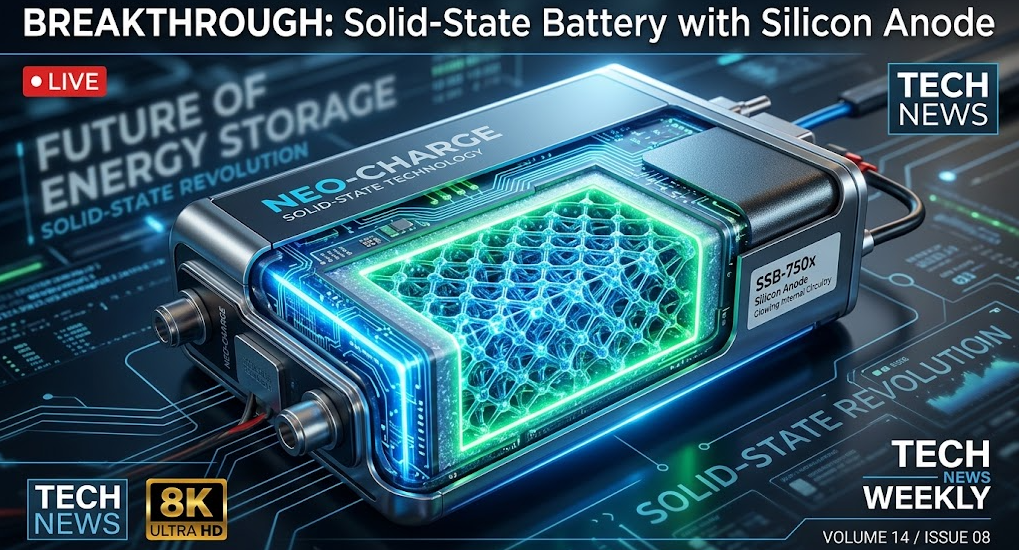
Alongside solid electrolytes, battery manufacturers are replacing standard graphite anodes with pure silicon or silicon-carbon composite anodes.
As detailed on Wikipedia’s Silicon Anode Battery overview, silicon can theoretically hold up to ten times more lithium ions by weight than graphite. Advanced nanostructured silicon engineering now mitigates the volumetric expansion issues that historically plagued early silicon prototypes.
Further industry benchmarks on commercial scaling can be explored via Battery Power Magazine.
AI-Driven Battery Management Systems (BMS)
Physical chemistry is only half of the modern energy equation. Managing state-of-charge, cell balancing, and degradation rates in solid-state packs requires high-precision algorithms.
As explored in our ongoing hardware breakdowns in Tech today, real-time neural networks integrated into onboard Battery Management Systems continuously predict temperature shifts and dynamic load spikes to maximize overall pack lifespan.
Looking Ahead: Commercial Horizons
While manufacturing scalability and cost per kilowatt-hour remain active engineering hurdles, initial pilot production lines are already supplying solid-state cells to premium EV fleets and high-end aerospace applications.
Over the coming decade, the transition to solid-state silicon chemistry will fundamentally reshape not only electric vehicles, but the entire portable electronics industry.