


By TechNews Editor | Published in Innovation & Hardware
The global volume of digital data is expanding at an exponential rate. From high-definition video archives to massive AI training datasets, traditional storage media—such as magnetic hard drives, flash memory, and magnetic tapes—are rapidly approaching physical and economic limits. Magnetic tape degrades within decades, while silicon-based flash memory requires substantial power and continuous physical expansion.
To solve this impending archival crisis, computer scientists and molecular biologists are turning to nature’s ultimate information storage system: DNA Data Storage.
Why Deoxyribonucleic Acid (DNA) is the Ultimate Storage Medium
DNA has encoded biological information for billions of years with unprecedented efficiency and durability. By converting binary computer code (0s and 1s) into the four nucleotide bases of DNA—Adenine (A), Cytosine (C), Guanine (G), and Thymine (T)—researchers can write digital files directly into synthesized genetic strands.
According to research published in Nature Biotechnology, molecular data storage offers three transformative advantages over silicon:
- Extreme Information Density: A single gram of synthetic DNA can theoretically store up to 215 petabytes (215,000,000 gigabytes) of data.
- Decades-Long Longevity: Unlike hard drives that degrade within 5–10 years, synthetic DNA preserved in cold, dry environments can remain fully readable for thousands of years without data loss.
- Zero-Power Archiving: Once written, DNA storage requires no electrical power or active cooling maintenance to preserve its contents.
The Workflow: Writing, Storing, and Reading Molecular Data
Industry standards championed by the DNA Data Storage Alliance outline a streamlined four-step process for molecular data retrieval:
- Encoding: Binary computer files are translated into nucleotide sequences using error-correcting algorithms.
- Synthesis: Chemical printers assemble custom DNA strands base by base according to the encoded sequence.
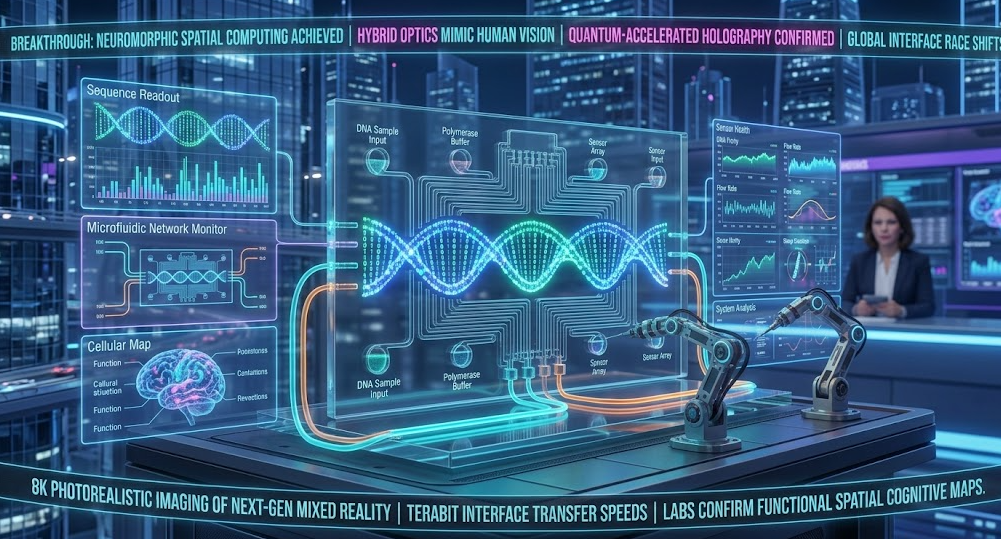
- Storage: Synthesized DNA strands are dried and sealed in micro-vials or embedded onto microfluidic chips.
- Sequencing & Decoding: Next-Generation Sequencing (NGS) machines read the nucleotide bases, which software algorithms decode back into original binary files.
Further technical details on molecular encoding can be explored via Wikipedia’s DNA Digital Data Storage overview.
Current Bottlenecks and Future Horizons
The primary obstacle preventing immediate widespread commercial adoption is the cost and speed of DNA synthesis. While reading DNA sequence data has become fast and inexpensive, chemically writing custom DNA bases base-by-base remains relatively slow compared to electronic memory.
However, as explored in our ongoing hardware breakdowns in Tech today, innovations in enzymatic DNA synthesis and microfluidic chip fabrication are rapidly reducing write costs.
Looking Ahead: The Cold Data Revolution
DNA data storage is not intended to replace high-speed RAM or solid-state drives in consumer laptops. Instead, its immediate value lies in hyperscale cold storage—preserving historical archives, scientific databases, and enterprise backups for centuries.
As molecular writing technologies mature, synthetic biology will establish itself as a cornerstone of next-generation cloud storage infrastructure.