


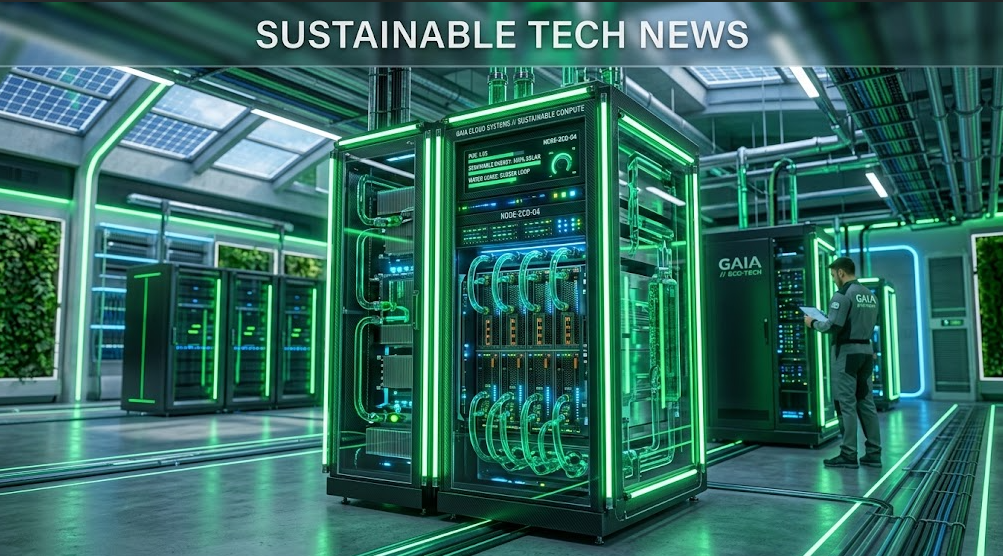
By TechNews Editor | Published in Innovation & Hardware
The exponential rise of generative artificial intelligence and high-performance cloud computing has created an unprecedented demand for computational power. Modern server racks hosting thousands of specialized AI accelerators can draw over 100 kilowatts of power per rack—nearly ten times the power density of traditional web hosting hardware.
As a result, tech giants and cloud infrastructure providers face an urgent dual challenge: managing extreme thermal output while reducing carbon footprints to meet global sustainability targets.
The Physical Limits of Traditional Air Cooling
For decades, data centers relied on forced-air HVAC systems to regulate ambient temperatures. Cold air was pushed through raised floors, passed across heated microchip heatsinks, and vented away.
However, as highlighted in reports by the U.S. Department of Energy (DOE), air cooling is reaching its physical limits. Air is a poor thermal conductor compared to liquid, requiring massive arrays of high-RPM fans that consume up to 40% of a facility’s total electricity budget just for thermal management.
The Shift to Liquid Cooling Solutions
To prevent thermal throttling and optimize power usage effectiveness (PUE), hardware architects are adopting advanced Liquid Cooling Systems. According to technical breakdowns on Data Center Knowledge, two main methods are dominating high-density deployments:
1. Direct-to-Chip (Cold Plate) Cooling
Liquid coolant is pumped directly through closed-loop copper plates attached directly to the CPU and GPU dies. Because liquid transfers heat over 20 times more efficiently than air, chips can run continuously at maximum clock speeds without overheating.
2. Immersion Cooling
Entire server chassis are submerged in specially engineered non-conductive (dielectric) fluid. The fluid absorbs heat directly from all board components—including memory chips and power delivery circuits—and cycles it through external heat exchangers. This method completely eliminates noisy fans and reduces facility cooling power demands by up to 90%.
Measuring Sustainability: Green Computing Frameworks
As defined on Wikipedia’s overview of Green Computing, sustainable IT architecture focuses not only on power reduction during operation, but across the entire lifecycle of hardware:
- PUE (Power Usage Effectiveness): Lowering the ratio of total facility power to actual IT equipment consumption closer to an ideal score of 1.0.
- Heat Reuse Initiatives: Capturing waste hot water from liquid-cooled servers to heat nearby residential buildings or agricultural greenhouses.
- Renewable Energy Integration: Pairing high-density compute clusters directly with adjacent solar, wind, or geothermal power generation.
Balancing Compute Power and Environmental Impact
As discussed in our previous hardware breakdowns in Tech today, the silicon industry can no longer rely purely on shrinking transistor nodes to improve efficiency. Sustainable computing requires a holistic approach—combining energy-efficient NPU architectures with cutting-edge liquid cooling.
The future of supercomputing won’t just be measured in teraflops or operations per second, but in compute per watt. Facilities that successfully integrate sustainable cooling technologies will define the next generation of cloud infrastructure.