


By TechNews Editor | Published in Innovation & Hardware
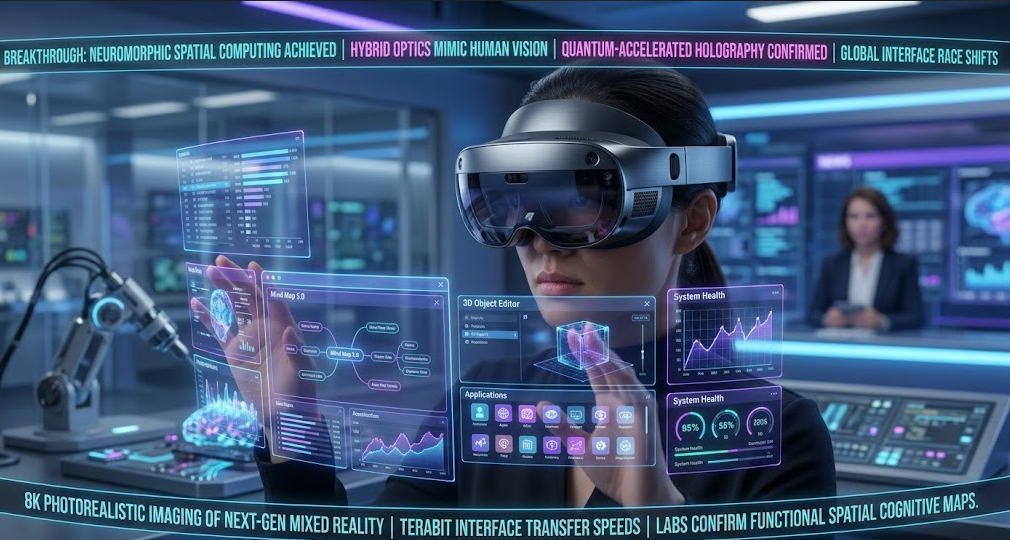
The boundary between physical and digital reality is becoming increasingly porous. While early virtual reality headsets relied on bulky LCD displays and high latency, the modern era of Spatial Computing is driven by breakthrough hardware micro-architectures that render ultra-realistic digital elements onto the physical world in real time.
From enterprise spatial design to immersive surgical simulations, the hardware stack behind Mixed Reality (MR) is undergoing a massive evolutionary leap.
Micro-OLED Displays: Pushing Pixel Density Boundaries
The primary hardware hurdle for Spatial Computing has long been the “screen-door effect”—where users can discern individual pixels due to low resolution. To eliminate this distortion, display manufacturers are replacing traditional smartphone-grade panels with Silicon-based Micro-OLED (OLEDos) displays.
According to technical benchmarks highlighted by Sony Semiconductor, micro-OLED panels achieve pixel densities exceeding 3,000 pixels per inch (PPI). By fabricating OLED layers directly onto silicon wafers, manufacturers can deliver dual-4K imagery per eye, matching the visual fidelity of human sight.
Eye-Tracking and Foveated Rendering Architectures
Rendering photorealistic 3D environments at high refresh rates requires immense graphical compute power. To prevent thermal throttling on standalone headsets, hardware designers employ Foveated Rendering guided by infrared eye-tracking sensors.
As detailed in research from the IEEE Computer Society, foveated rendering takes advantage of human foveal vision:
- Foveal Zone: The headset renders maximum graphical detail and shading strictly where the user’s pupil is directly pointing.
- Peripheral Zone: Regions outside the immediate line of sight are rendered at a significantly lower resolution, reducing GPU workload and power consumption by up to 60%.
Real-Time Spatial Mapping and Sensor Fusion
To anchor virtual objects permanently to physical walls or tables without drifting, headsets rely on low-power sensor arrays. As outlined on Wikipedia’s Spatial Computing framework, modern spatial headsets process continuous data streams using:
- ToF (Time-of-Flight) Depth Sensors: Mapping physical room geometry with sub-millimeter precision.
- Pass-Through Cameras: Low-latency video capture that blends physical surroundings with digital overlays without motion sickness.
- Dedicated Spatial Processors: Offloading sensor fusion calculations away from the main system processor to keep latency well below 12 milliseconds.
Looking Ahead: The Form Factor Race
As explored in our ongoing hardware breakdowns in Tech today, the ultimate commercial goal is shrinking spatial computing components down from bulky headsets into lightweight everyday smart glasses.
With high-efficiency NPU accelerators, advanced micro-OLED optics, and eye-tracking algorithms advancing in tandem, spatial computing is poised to replace traditional desktop monitors over the coming decade.