


By TechNews Editor | Published in Innovation & Hardware
Over the past few years, artificial intelligence has primarily relied on massive hyperscale data centers. Every time a user executes a voice command, generates an image, or requests code assistance, the query travels across global networks to remote cloud servers before returning a response.
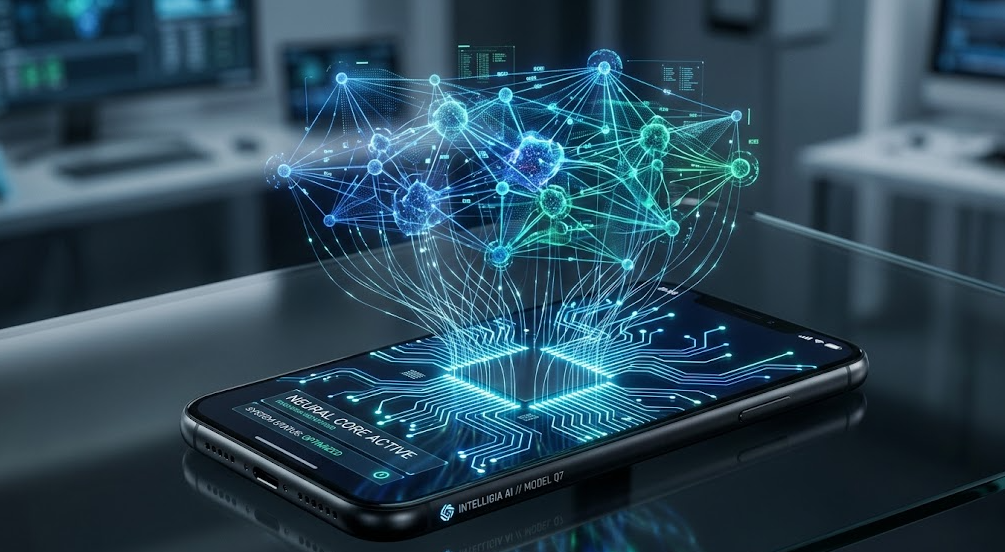
However, this server-centric model is rapidly reaching its structural limits due to network latency, bandwidth constraints, and growing user privacy concerns. The industry is now undergoing a massive paradigm shift toward Edge AI—processing intelligence directly on smartphones, laptops, and IoT devices powered by dedicated Neural Processing Units (NPUs).
The Rise of Dedicated Neural Processing Units (NPUs)
Traditionally, mobile and desktop processors relied on the CPU for general calculations and the GPU for graphics rendering. As explained on Wikipedia’s Neural Processing Unit overview, an NPU is a specialized silicon accelerator designed specifically to execute deep learning algorithms using minimal power.
Instead of competing with the GPU for memory bandwidth, NPUs process matrix math natively. This architectural shift enables continuous background AI workloads—such as real-time audio translation, eye tracking, and image segmentation—without draining battery life.
Why Tech Giants are Shifting from Cloud to Edge Computing
Major chipmakers and tech ecosystems are aggressively integrating high-TOPS (Trillions of Operations Per Second) NPUs into their consumer hardware. For instance, announcements from Apple Newsroom and detailed technical guides on Qualcomm Insights emphasize three fundamental advantages of on-device processing:
1. Near-Zero Latency and Real-Time Responsiveness
When AI models run locally on silicon, round-trip network delays are completely eliminated. This allows instant text generation, immediate camera auto-focus adjustments, and zero-delay real-time language translation.
2. Enhanced Privacy and Data Security
Data breaches remain a primary concern for consumers and enterprises. Local execution ensures that sensitive personal data, biometric scans, and proprietary documents never leave the physical device, satisfying strict regulatory standards.
3. Offline Functionality and Bandwidth Efficiency
On-device models allow smart features to function seamlessly in remote locations with zero cellular coverage, while simultaneously relieving pressure on global internet infrastructure.
Hybrid AI: Bridging the Edge and Cloud
While NPUs are becoming increasingly capable, running massive multi-billion parameter large language models (LLMs) entirely on a smartphone remains impractical. As highlighted in our previous hardware breakdowns in Tech today, the market is coalescing around a Hybrid AI model.
In this architecture:
- Local NPUs handle instantaneous, privacy-sensitive, and lower-complexity tasks (e.g., photo editing, context awareness, personal assistant queries).
- Cloud Supercomputers step in only when complex, multi-modal reasoning or massive dataset queries are requested.
Looking Ahead: The Silicon Race on Your Wrist and Pocket
As semiconductor foundries shrink manufacturing processes down to 2nm and integrate High-Bandwidth Memory directly into consumer SoCs, the computational capability of pocket devices will soon rival yesterday’s enterprise servers.
For software developers and device manufacturers, optimization is now the top priority. The winning platforms of the coming decade won’t just be those with the largest cloud data centers, but those that deliver the smartest, most efficient silicon directly into the user’s hand.