



By TechNews Editor | Published in Innovation & Hardware
For over half a century, modern computers have operated on the traditional von Neumann architecture, where processing and memory units are physically separated. While this structure enabled the desktop revolution, the explosive demand for deep neural networks has highlighted its core bottleneck: massive energy consumption caused by constantly transferring data between memory and processors.
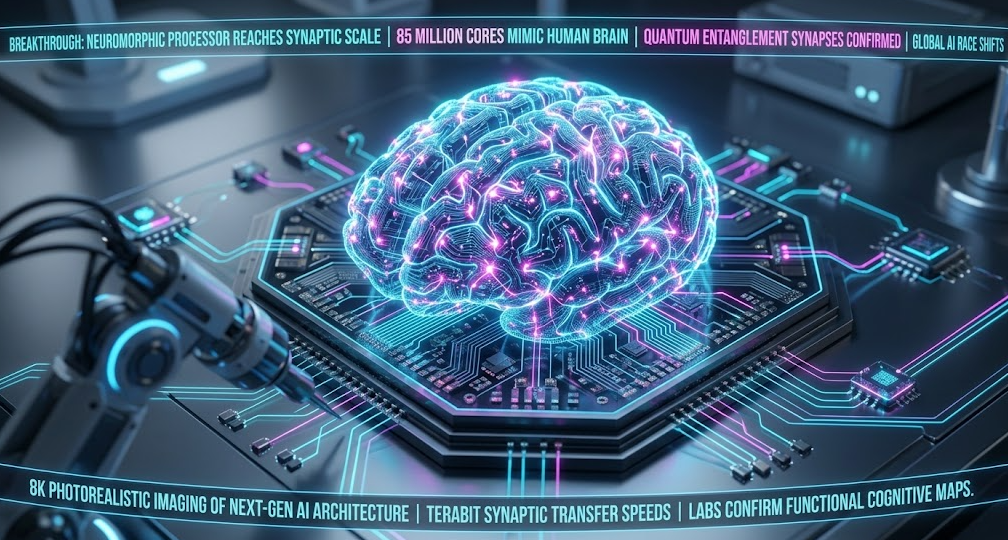
To break through this barrier, hardware researchers are turning to biology, developing Neuromorphic Computing—silicon architectures engineered to mimic the structure, mechanism, and efficiency of the human brain.
The Biological Inspiration: Event-Driven Processing
The human brain processes vast amounts of sensory information while consuming a mere 20 watts of power. Traditional GPUs, by contrast, run continuously at peak power draw, continuously checking every pixel or clock cycle regardless of whether new data has arrived.
As detailed in research published in Nature, neuromorphic processors utilize Spiking Neural Networks (SNNs). Instead of processing data synchronously on a fixed system clock, these chips operate on an event-driven basis:
- Synaptic Plasticity: Memory and compute units are integrated directly into artificial neurons and synapses, eliminating external memory data transfers.
- Asynchronous Spikes: Individual artificial neurons consume power only when they receive a “spike” of new data, reducing idle energy consumption by up to 99%.
Industry Breakthroughs in Brain-Inspired Hardware
Leading semiconductor research divisions are moving neuromorphic concepts out of academic laboratories and into functional hardware prototypes.
As highlighted in technical publications from Intel Labs, specialized neuromorphic research chips demonstrate unprecedented power efficiency in real-time edge processing tasks—such as gesture recognition, acoustic classification, and adaptive robotics control—using a fraction of the milliwatts required by traditional silicon.
Further background on spiking architecture can be explored via Wikipedia’s Neuromorphic Engineering overview.
Real-World Applications at the Edge
Neuromorphic computing is not intended to replace high-throughput graphics cards in enterprise training clusters overnight. Instead, its immediate value lies in real-time, low-power edge applications:
- Prosthetics and Bio-Interfaces: Processing nerve impulses with sub-millisecond response times and negligible thermal output.
- Autonomous Drone Navigation: Analyzing optical flow and obstacle avoidance in micro-drones where battery payload is severely limited.
- Continuous Sensor Monitoring: Running permanent background voice and anomaly detection in smart wearables without draining daily battery life.
The Path to Commercialization
As explored in our ongoing coverage of next-gen chip architectures in Tech today, the future of silicon relies on combining specialized co-processors. Neuromorphic chips will likely serve as dedicated, hyper-efficient event monitors operating alongside primary NPUs and CPUs.
By bridging the gap between biological efficiency and silicon fabrication, neuromorphic engineering paves the way toward truly autonomous, always-on artificial intelligence.