


By TechNews Editor | Published in Innovation & Hardware
For decades, silicon-based transistors have powered the global technological revolution, adhering closely to the observations of Moore’s Law. However, as chipmakers shrink logic gates down to physical limits near atomic scales, traditional silicon architecture faces insurmountable challenges—namely quantum tunneling, extreme thermal output, and severe energy leakage.
To sustain the relentless pace of modern computational demands—especially with the rise of massive neural networks and real-time complex simulations—the tech industry is pivoting toward two groundbreaking paradigms: Quantum Computing and Silicon Photonics.
The Physical Limits of Modern Silicon Integration
As highlighted in recent research on Semiconductor Engineering, modern sub-3nanometer process nodes are pushing physical chemistry to its absolute boundary. Electrons no longer stay neatly contained within tiny silicon pathways, leading to power dissipation issues and diminishing performance returns.
While specialized accelerators like modern NPUs and custom GPUs are extending silicon’s lifespan—as explored in our previous coverage on next-gen AI microchip architecture—researchers agree that silicon alone cannot handle the compute requirements of the next decade.
1. Silicon Photonics: Speed of Light Interconnects
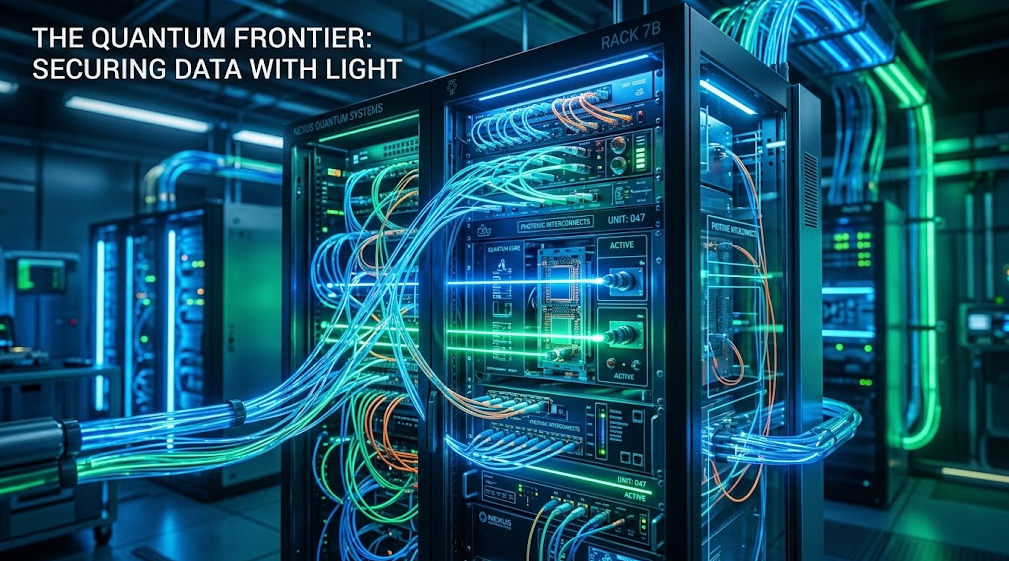
Instead of relying solely on electrical signals moving through copper wires, Silicon Photonics uses photons (particles of light) to transfer data between chips and processor cores at lightspeed.
Key advantages include:
- Near-Zero Latency: Optical interconnects transfer massive volumes of data with virtually zero delay compared to electrical wiring.
- Massive Bandwidth Expansion: Light signals across multiple wavelengths can travel concurrently through a single optical fiber without signal degradation.
- Dramatic Energy Reduction: Eliminating resistance-based heat generation reduces datacenter cooling requirements by up to 40%.
Major chipmakers are actively integrating optical engines directly onto silicon packages. For instance, NVIDIA’s Technical Blog frequently highlights how optical interconnects are becoming essential for connecting multi-node AI supercomputing clusters seamlessly.
2. Quantum Computing: Solving the Incalculable
While silicon photonics revolutionizes data transfer, Quantum Computing fundamentally alters how calculations are executed. Operating on qubits—which leverage superposition and entanglement—quantum processors can process vast solution spaces simultaneously.
Quantum Advantages in Real-World Applications
- Molecular Dynamics & Medicine: Simulating complex molecular structures in minutes to discover life-saving drugs.
- Cryptographic Security: Developing quantum-resistant encryption protocols to protect critical infrastructure.
- Financial & Logistics Optimization: Optimizing global supply chains and portfolio risks in real time.
Hybrid Computing: The Bridge to Tomorrow
We are not replacing traditional silicon overnight. Instead, the immediate future belongs to hybrid architectures: high-density silicon compute engines connected via optical photonics, paired with quantum coprocessors for hyper-specific computational tasks.
For tech platforms, developers, and hardware engineers, understanding this multi-disciplinary hardware landscape is critical. The next era of computing won’t just be about adding more transistors—it will be about fundamentally shifting the physics behind how information moves and processes.