
The legendary investor Warren Buffett once described the stock market as a “giant casino,” highlighting how many people are willing to risk their money in hopes of becoming rich.
This comparison frequently appears in financial discussions. Buffett is not the only expert to draw this parallel—many analysts use it to criticize high-risk strategies such as leveraged trading and Contracts for Difference (CFDs).
However, when we examine the definitions of these two concepts more closely, a clear distinction becomes apparent. According to the Merriam-Webster dictionary, they are defined as follows:
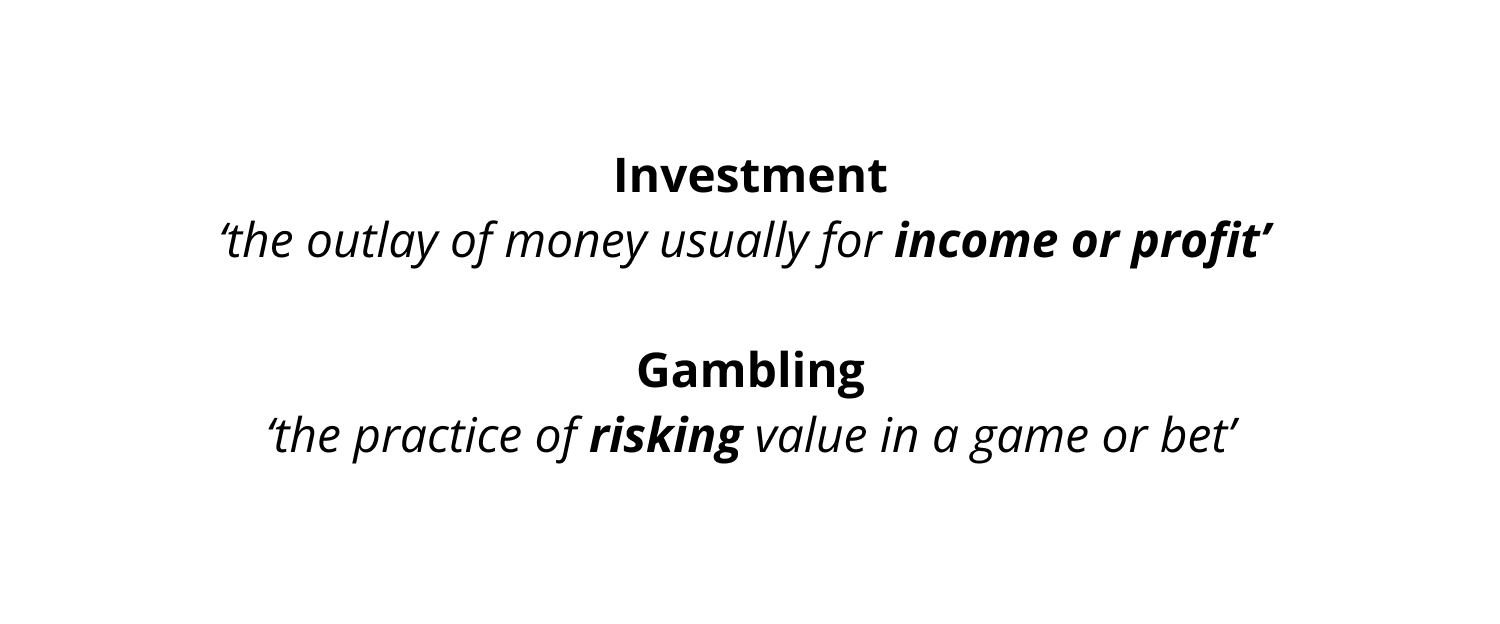
At first glance, there’s a clear and important distinction. In its purest definition, investing is about expecting long-term profit, while gambling is primarily associated with risk and the possibility of loss.
So why do so many people confuse investing with gambling? Should these two concepts really be placed in the same category?
In this article, we’ll explore the comparison between investing and gambling, analyzing whether this popular analogy truly holds up. We’ll also apply insights from experts in both fields to get a more balanced perspective.
From the investment side, we’ve gathered opinions from PhD-level finance professors and experienced investors. On the gambling side, we’ll share expert knowledge of betting strategies and how the process actually works.
Our goal is to provide a clear, in-depth answer to the question: is investing really the same as gambling? Along the way, we’ll also debunk some common myths surrounding both.
What Investing and Gambling Have in Common
To better understand why people often compare investing and gambling, it’s important to look at the key similarities these two activities share.
Both Involve Risking Money for Potential Profit
At their core, both investing and gambling involve putting money at stake with the hope of getting more in return. Whether you’re placing a bet or making an investment, the goal is the same—generate profit.
However, it’s also important to recognize that there’s always a chance of losing money. That’s why many experts suggest treating investments as “money you can afford to lose.” This mindset helps manage risk and prevents emotional decision-making.
Still, the possibility of earning more than what you initially put in is what drives both investors and gamblers alike.
Both Are Subject to Risk
One of the most important similarities between investing and gambling is risk. Without the ability to predict the future, every financial decision carries some level of uncertainty.
External factors—often beyond our control—play a major role in determining outcomes in both activities.
In gambling, this uncertainty is largely driven by chance. For example, in slot games, outcomes are determined by a Random Number Generator (RNG), making results completely unpredictable.
Stock markets, on the other hand, are influenced by a wide range of external forces. We’ve all seen how volatile the market can be, with prices rising and falling dramatically in a short period of time.
A recent example is the GameStop phenomenon, where Reddit users leveraged the power of social media to drive the company’s stock price up by more than 1,000% in just two weeks. This event clearly demonstrated how unpredictable market movements can be, even for experienced investors.